
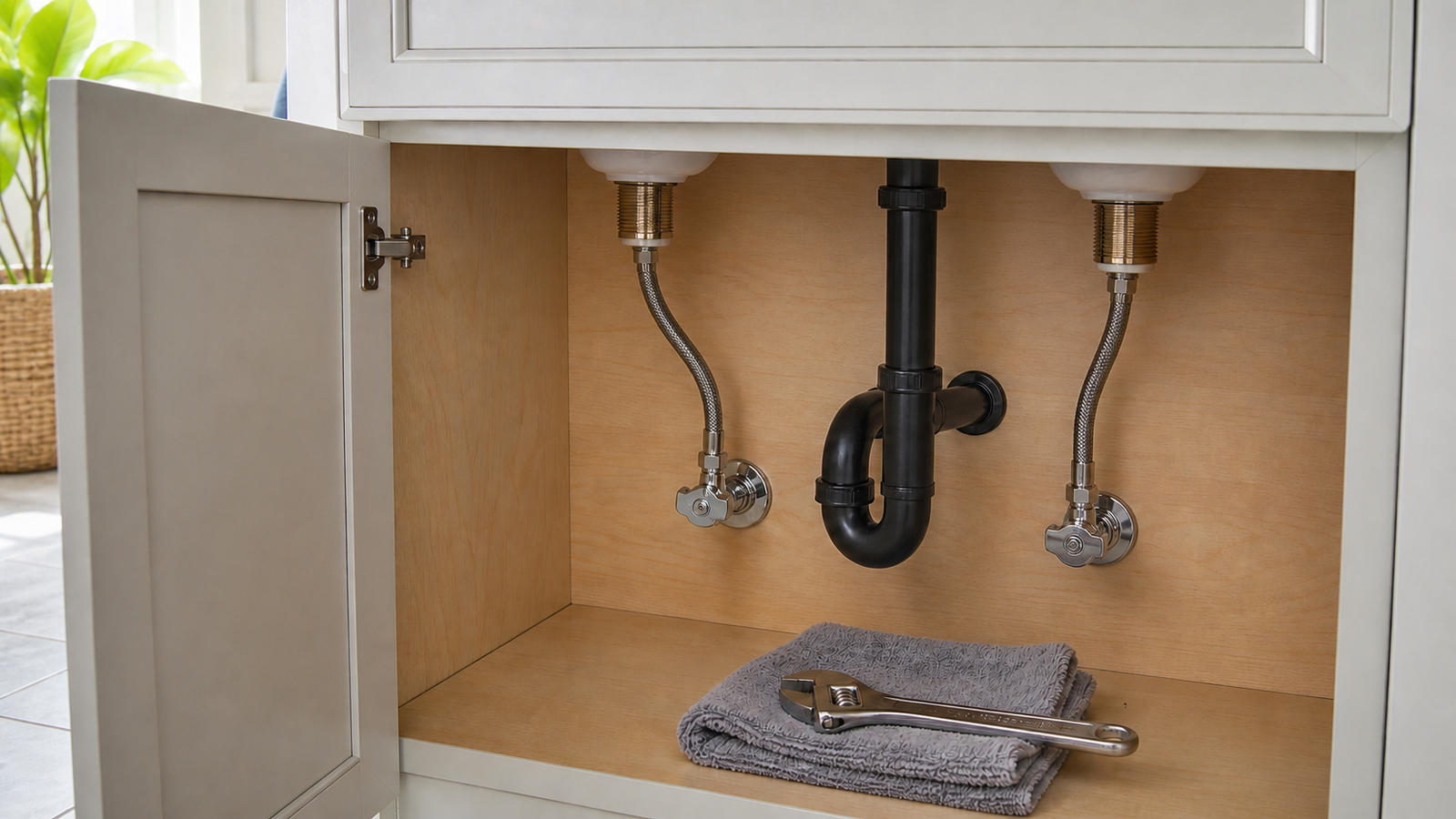
Safety boundary
Stop and reassess if
- Turn off water at the fixture shutoff valves before disconnecting any supply lines, and keep a bucket and towels ready to catch residual water in the lines.
- Do not overtighten compression fittings or threaded couplings—excessive force strips threads or cracks the fitting bodies, causing leaks that worsen over time.
- Inspect shutoff valves for corrosion, damage, or leaks before installing new supply lines, as defective valves will cause problems regardless of connector quality.
- Never use supply lines that show kinks, cuts, or damage to the braiding or outer jacket, as these defects compromise burst resistance and lead to failure.
- Replace supply lines that have been in service for more than ten years even if they appear functional, as the inner tubes degrade over time and may fail without warning.
- Call a licensed plumber if you lack individual fixture shutoff valves, discover damaged valves, or encounter non-standard pipe sizes or connection methods.
Faucet supply lines connect your home's water supply to individual fixtures, and choosing the wrong length or material creates problems ranging from kinked hoses to catastrophic leaks. These flexible connectors replaced older rigid copper tubing in most residential applications because they simplify
The supply line market offers dozens of options at various price points, but not all connectors suit every application. Material choice affects durability, flexibility, and resistance to corrosion. Length determines whether the line installs without stress or dangerous kinks. End fittings must match
Understanding Supply Line Materials
Braided stainless steel supply lines dominate the residential market because they combine flexibility with burst resistance. These connectors feature an inner tube—typically PVC or rubber—surrounded by a woven stainless steel jacket. The braiding provides mechanical protection and contains the inner
PEX supply lines use cross-linked polyethylene tubing without external braiding. These connectors cost less than braided stainless options and resist corrosion from minerals in hard water. The material remains flexible at low temperatures and tolerates slight freezing better than lines with rubber c
Polymer-braided supply lines feature a plastic outer jacket instead of stainless steel. Manufacturers market these as corrosion-proof alternatives for coastal areas or homes with aggressive water chemistry. The polymer braiding provides less burst protection than stainless steel, and these connector
Copper supply lines represent the traditional approach, using rigid or semi-rigid tubing bent to fit between valve and faucet. Professional plumbers still install copper in commercial settings and high-end residential work, but the material requires tube-bending skills and precise measurement. Homeo
Measuring for the Correct Length
Supply line length must account for the actual path the connector travels, not just the straight-line distance between valve and faucet. Measure from the center of the shutoff valve outlet to the center of the faucet inlet, then add four to six inches to allow for gentle curves and slight position a
Avoid the temptation to buy the longest available line for every application. Excess length forces you to coil or loop the connector, which creates stress points and reduces the effective working space under the sink. A 12-inch line works for most bathroom vanities where the shutoff valve mounts dir
Check the actual installed position before purchasing connectors. Turn off the water supply and disconnect the old supply line if one exists, then hold a tape measure along the path the new line will follow. Note any obstructions like garbage disposals, drain pipes, or cabinet bracing that force the
Standard supply line lengths increase in two-inch increments: 12, 16, 20, 24, 30, and 36 inches are common retail offerings. Some manufacturers produce 9-inch and 48-inch versions for special applications. When your measurement falls between standard sizes, choose the next longer option rather than
Matching Thread Sizes and Connection Types
Faucet supply lines use compression fittings or threaded couplings at both ends, and these fittings must match the threads on your shutoff valve and faucet. The valve end typically connects using a 3/8-inch or 1/2-inch compression fitting that slides over the valve outlet and tightens with a compres
Most residential faucets use 3/8-inch inlet threads, making 3/8-inch by 3/8-inch supply lines the most common configuration. Kitchen faucets with pull-down sprayers or pot-filler features may specify 1/2-inch inlets for higher flow rates. Check your faucet documentation or measure the existing conne
Shutoff valve outlets come in 3/8-inch and 1/2-inch compression sizes, with 3/8-inch being standard for most bathroom and kitchen installations. The compression fitting on the supply line must match this valve size exactly. Some supply lines feature a 1/2-inch compression fitting at the valve end an
Angle stops and straight stops require the same supply line fittings, but the connector must approach from different directions. Angle stops have outlets perpendicular to the inlet, typically used where supply pipes emerge from the wall. Straight stops have aligned inlet and outlet, common where pip
Evaluating Quality Indicators
Supply line quality varies dramatically even among products that appear similar on the shelf. Examine the end fittings closely—premium connectors use solid brass couplings with thick walls and deep thread engagement. Budget versions substitute plated zinc or thin brass that strips easily during inst
Inspect the crimp where the hose attaches to the end fitting. Quality manufacturers use double crimps or rolled edges that capture the hose securely without cutting into the material. A single shallow crimp or visible gaps between hose and fitting indicate poor manufacturing that may fail under pres
Check the braiding pattern on stainless steel supply lines. Tight, uniform braiding with no gaps or loose strands indicates better manufacturing. The braid should extend fully to the end fittings without exposing the inner tube. Some budget lines leave the tube exposed near the couplings, creating a
Read the pressure rating printed on the connector or packaging. Residential supply lines should handle at least 125 PSI working pressure, with burst ratings of 500 PSI or higher. Lines rated for lower pressures may work in typical homes but provide no safety margin for pressure spikes from water ham
Considering Installation Environment
The space where the supply line installs affects material selection and length requirements. Under-sink cabinets in kitchens often contain garbage disposals, hot water dispensers, and complex drain assemblies that leave little room for supply line routing. Choose connectors with enough length to nav
Bathroom vanities typically offer more working space but may have decorative elements or drawer mechanisms that interfere with supply lines. Measure with cabinet doors and drawers fully open to ensure the connectors don't contact moving parts. Wall-mounted faucets require longer lines that remain vi
Temperature extremes influence material performance. Supply lines in unheated spaces or exterior walls should use materials that tolerate freezing. PEX handles cold better than rubber-core braided lines, which become stiff and brittle at low temperatures. Hot water supply lines experience constant t
Water chemistry affects long-term durability. Homes with very hard water, high chlorine levels, or acidic well water accelerate deterioration of rubber and PVC inner tubes. Stainless steel braiding resists external corrosion, but the inner tube still contacts the water and degrades over time. PEX su
Recognizing When Professional Help Is Needed
Replacing supply lines on existing faucets with accessible shutoff valves falls within the capability of careful homeowners who follow instructions and use appropriate tools. The work involves no electrical components, requires no special licensing, and creates manageable consequences if mistakes oc
Call a licensed plumber if your home lacks individual fixture shutoff valves. Installing shutoff valves requires cutting into supply pipes, soldering or using compression fittings on pressurized lines, and understanding local plumbing codes. This work exceeds typical homeowner skills and creates sig
Seek professional help when supply line replacement reveals corroded or damaged shutoff valves. Valves that won't close completely, leak around the stem, or have corroded threads need replacement before new supply lines will function properly. Attempting to force connections onto damaged valves caus
Contact a professional if you discover supply pipes that don't match standard sizes or use unfamiliar connection methods. Some older homes have metric fittings, proprietary connection systems, or non-standard pipe materials that require special adapters or techniques. Forcing incompatible parts toge
Get expert assistance for faucet installations that involve structural modifications, such as drilling through countertops, cutting tile, or modifying cabinetry. While supply line selection remains straightforward, the surrounding work requires skills and tools beyond basic plumbing. Similarly, if y
Verifying Your Selection Before Purchase
Before leaving the store or completing an online order, confirm that your selected supply lines match all requirements. Check that the length accommodates your measured distance plus extra for routing. Verify that both end fittings match your valve and faucet thread sizes—a 3/8-inch compression fitt
Buy supply lines in pairs for two-handle faucets or single-handle models with separate hot and cold inlets. Some faucets use a single supply line with an internal mixing valve, but most require two connectors. Purchase an extra set if you're replacing lines on multiple fixtures during the same proje
Keep your receipt and packaging until installation is complete and you've verified leak-free operation for at least 24 hours. Quality supply lines rarely fail immediately, but manufacturing defects occasionally cause problems. Most retailers accept returns of unused plumbing parts, and some will exc
Consider purchasing a basin wrench if you don't already own one. This specialized tool reaches into tight spaces behind sinks to tighten the faucet end of supply lines where standard wrenches won't fit. While not strictly necessary for supply line selection, having the right installation tools preve
Sources
Original information
- WaterSense Home Maintenance — U.S. Environmental Protection Agency
- Fix a Leak Week — U.S. Environmental Protection Agency